Almost everything you eat has been modified by humans.
We have only recently discovered how to do it a little faster.

When you walk into a grocery store today, it’s easy to think that the fruits, vegetables, and grains you see are natural products of the Earth. But in reality, most of what you eat has been carefully crafted by human hands over millennia.
Our ancestors didn’t have fancy labs or gene-editing tools, but they were skilled in the art of selective breeding - choosing plants with the best traits and encouraging them to flourish.
In fact, almost nothing you eat today exists in the wild. Melons, bananas, tomatoes - none of these crops looked or tasted the way they do now when they were first found in nature.
By selectively breeding plants for size, taste, yield, and resilience, early humans dramatically reshaped our food supply.
Imagine you’re an early farmer thousands of years ago. You find a wild plant that has small, bitter fruits. But one day, you stumble upon a plant with slightly larger, sweeter fruits. Naturally, you save seeds from that plant, hoping the next crop will carry those desirable traits.
Over time, through careful observation and selection, you end up with a crop that’s more nutritious, more plentiful, and far tastier than anything found in the wild.
It took hundreds - even thousands - of years to turn wild grasses into wheat, wild berries into strawberries, and bitter tubers into the potatoes we enjoy today. By passing on the best traits from one generation to the next, early farmers laid the foundation for all modern agriculture.
But what if we could speed up this process? What if instead of taking thousands of years to develop better crops, we could do it in decades—or even faster? That’s where modern techniques like genetic engineering come in.
Today, science allows us to build on the work of our ancestors, but with precision and speed they could only dream of.
In this article, we’ll journey from the early days of plant breeding to the cutting-edge technologies that are reshaping food as we know it. From selective breeding to gene-editing, we’ll explore how humans have always shaped the crops we rely on - and why the science of today is just the latest chapter in that long history.
Early Humans: The First Plant Breeders
The humble carrot is a great example to start with. Originally, wild carrots were small, bitter, and purple. Through selective breeding, farmers turned them into the larger, sweeter, and bright orange vegetables we now know.
Likewise, watermelons once resembled hard, small, and mostly inedible fruits. Thousands of years of careful cultivation transformed them into the juicy, refreshing summer snack we love today.
Even the crops that feed billions - like wheat and rice - are the products of human intervention. Early farmers selected grains that didn’t easily fall off the plant, allowing for easier harvesting and bigger yields. These early choices were the start of agriculture, shaping civilizations, and enabling populations to grow and thrive.
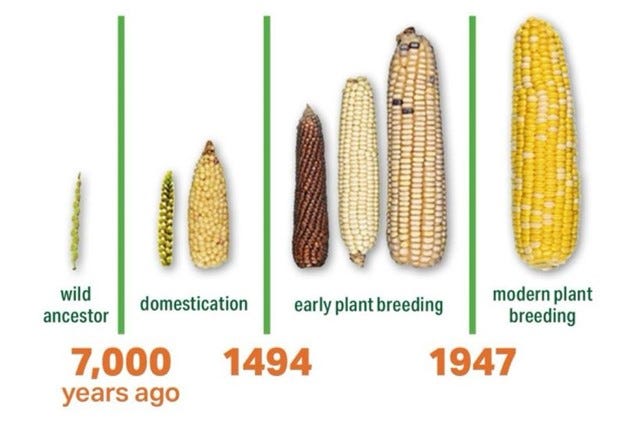
Take teosinte, for example. Thousands of years ago, teosinte was a wild grass with tiny, barely edible kernels – the wild ancestor of modern corn. But early farmers in what is now Mexico saw its potential. By continually selecting plants with larger and tastier kernels, they transformed teosinte into what we now know as maize - or modern corn. Corn as we eat it today looks nothing like its wild ancestor. It’s sweeter, juicier, and much larger, all thanks to centuries of selective breeding.
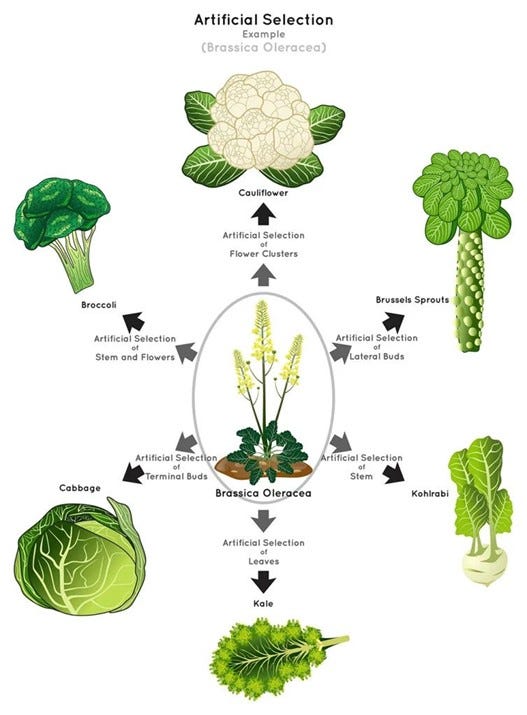
Another example is wild mustard. Early farmers noticed that different parts of the plant - leaves, stems, buds - could be selectively bred to emphasize particular traits.
From wild mustard, we have bred a wide variety of vegetables, each with its own unique characteristics:
Cabbage (bred for its large terminal buds)
Broccoli (bred for its flower buds)
Kale (bred for its leaves)
Cauliflower (bred for its flower clusters)
Without knowing it, early humans were essentially acting as genetic engineers, selecting the traits they valued most and slowly transforming wild plants into staple crops and at the same time created the dreaded Brussels Sprouts.
This process, known as domestication, took thousands of years, but the results are the fruits and vegetables we recognize today.
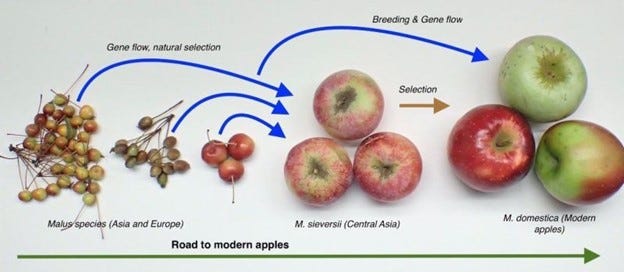
One of the earliest examples of domesticated fruit is the apple. Wild apples, native to Central Asia, were small, bitter, and tough. But by selecting apples that were larger, sweeter, and juicier, farmers transformed them into the diverse varieties we have today. The Malus sieversii (wild ancestor of today’s apples) still exists, but it bears little resemblance to the apples you find in grocery stores.
Early farmers didn’t understand the genetic principles behind this transformation. But they didn’t need to—they simply picked the best, year after year, until they had crafted entirely new species.
Enter Gregor Mendel: The Father of Genetics
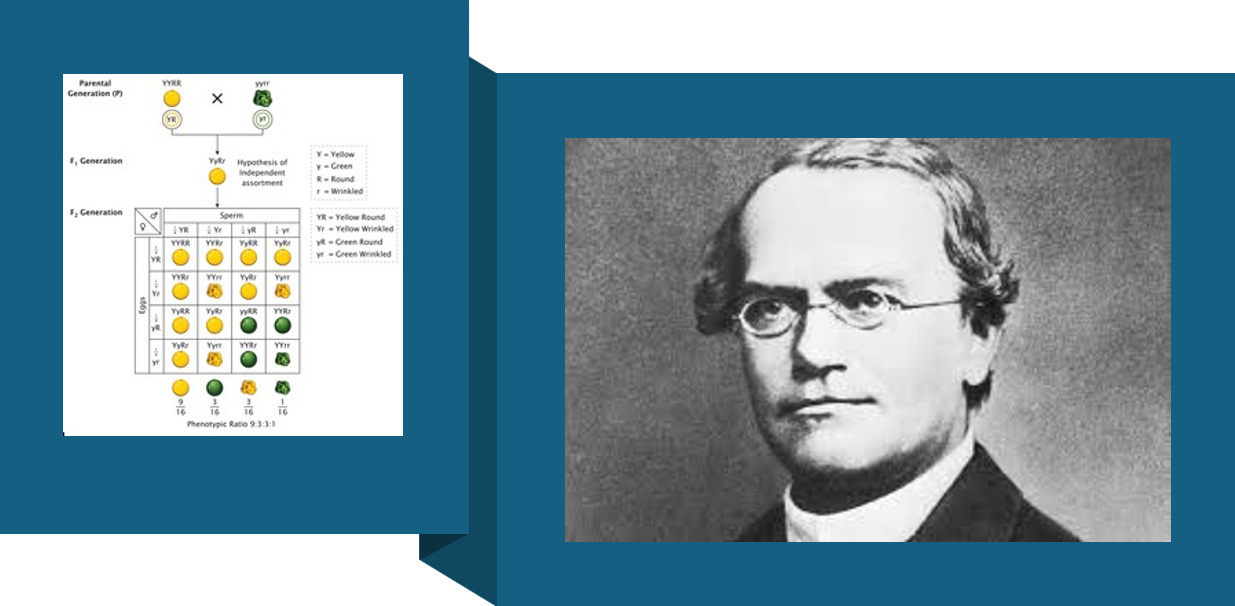
Fast forward to the 19th century, and a monk named Gregor Mendel discovered the laws of inheritance by crossbreeding pea plants. Mendel showed how traits like color and shape passed from one generation to the next, laying the groundwork for modern plant breeding. Thanks to him, we began to understand the “rules” of genetic inheritance - though humans had been unknowingly applying them for thousands of years.
We have only recently discovered how to do it a little faster
For thousands of years, humans have been patiently tweaking and perfecting our crops through selective breeding. Whether it was creating sweeter fruits or hardier grains, this process took time -a lot of time. In some cases, it took decades or even centuries to fully develop a desirable trait. But now, with modern genetic engineering and gene-editing techniques, we can do it all much faster and with far more precision.
Speeding up the process of crop improvement isn’t just about saving time - it’s about meeting the needs of a rapidly changing world. Climate change, population growth, pest outbreaks, and food insecurity are all urgent problems that demand fast, effective solutions.
Traditional breeding is slow and unpredictable, while genetic engineering offers precision and speed. By embracing these modern tools, we can achieve in a few years what once took centuries.
Accelerating Evolution
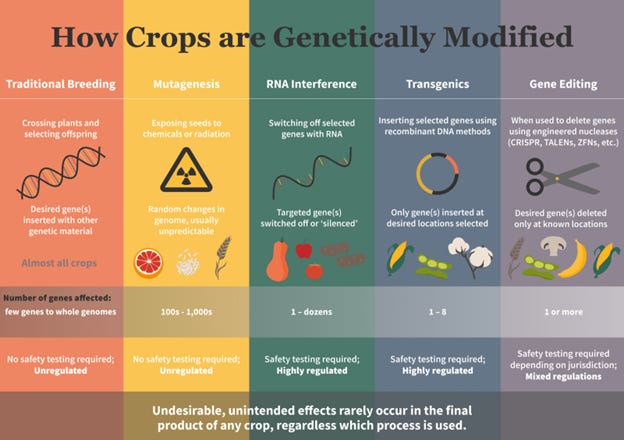
Mutagenesis is a fascinating technique that exposes plants to chemicals or radiation to induce random genetic mutations. These mutations are entirely unpredictable (and outdated), there is no precise control over the outcome. However, by screening large numbers of plants after exposure, desirable traits can be identified and selected. Think of it as speeding up the natural process of evolution in a controlled environment.
Unlike traditional breeding, where the focus is on selecting existing traits, mutagenesis actively creates new genetic variations that wouldn’t occur naturally. It has been used for decades to enhance crops for desirable traits such as yield, disease resistance, or even taste and color.
GMOs: Precision with Purpose
Genetically Modified Organisms (GMOs) are the next step in humanity’s long history of modifying plants for food. Unlike traditional breeding or mutagenesis, which rely on random genetic changes or slow selection processes, GMOs involve directly inserting specific genes into a plant’s DNA to introduce desirable traits. This precision allows scientists to target and solve specific agricultural challenges more efficiently and effectively.

In 2023 206.26 million hectares globally were planted with GM crops.
In 2023, the USA remained the leading country in terms of GM area, with 74.4 million hectares cultivated in 2023. Brazil, the second-largest GM area reached 66.9 million hectares.
Gene Editing: The Next Frontier
Gene editing is revolutionizing the way we approach crop improvement and food production. While GMOs involve inserting genes from one organism into another, gene-editing takes a more precise approach by altering an organism’s own DNA. Rather than adding foreign genes, gene editing allows scientists to make small, targeted changes to specific genes within a plant’s genome. This is done using advanced tools like CRISPR, TALENs, and ZFNs, which act like molecular scissors, cutting the DNA at precise locations.
Think of gene editing as a highly targeted version of selective breeding. Instead of waiting for nature to produce the desired traits over many generations, scientists can now directly tweak the genes responsible for those traits. It’s fast, accurate, and opens up possibilities we could only dream of a few decades ago.
Modern Genetic Engineering: Riskier Than Traditional Breeding? Not So Fast.
People often argue that because humans have been selectively breeding plants for thousands of years, it must be safe. On the other hand, modern genetic engineering - only around for a few decades - is viewed as riskier.
The thinking is, “If something’s been done for centuries, it must be better, right?”
→ Not exactly.
While traditional breeding has certainly been around a long time, it’s far from a perfect or risk-free process. In fact, it’s often less predictable than modern genetic engineering. Here’s why:
Selective breeding shuffles entire genomes. Thousands of genes are mixed together with very little control over what traits will emerge. Sure, you might get that larger fruit you wanted, but you might also end up with a plant that’s more prone to disease or other unintended consequences. It’s a trial-and-error approach that can take decades - or even centuries - to get right.
Genetic engineering, on the other hand, is like surgical precision. Scientists can target specific genes responsible for desirable traits like pest resistance or drought tolerance. Instead of shuffling the entire deck of genetic cards, they make small, precise changes, resulting in more control and fewer unknowns.
And here’s the kicker: while traditional breeding has been around for thousands of years, it doesn’t face the same rigorous testing that modern genetically engineered crops do. GMOs undergo years of safety assessments before they ever reach the market. Traditional crops, whether cross-bred or created through mutagenesis, don’t go through anywhere near the same level of scrutiny.
So, while genetic engineering may be newer, it’s actually more precise, better regulated, and, in many cases, less risky than traditional breeding methods.
Fact check:
Over 4,400 risk assessments on genetically modified crops have been conducted by scientists across more than 70 countries.
The conclusion? Every one found that GM crops pose no more risk to health or the environment than non-GM crops.
The idea that GMOs are harmful often comes from a misunderstanding of the technology. At its core, genetic modification is just a more precise extension of what humans have always done -shaping plants to better meet our needs.
When you walk into a grocery store today, it’s easy to think that the fruits, vegetables, and grains you see are natural products of the Earth - straight from nature to your shopping cart. But in reality, almost nothing you eat today looks or tastes the way it did in the wild. The truth is, most of the food we enjoy has been carefully shaped and crafted by human hands over thousands of years. Every apple, ear of corn, and even those juicy tomatoes you love have gone through centuries of tinkering, selection, and innovation.
→ Next time you sit down for a meal, thank thousands of years of plant breeding, modern science, farmers and a lot of human ingenuity.